
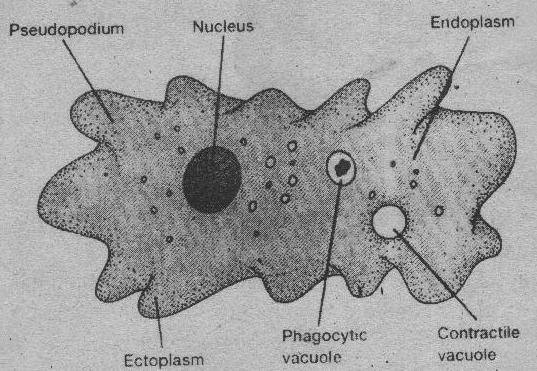
THE AMOEBOID PROTOZOA
Members Of the amoebozoans are the amoebae (sing.. amoeba). They form temporary cell extensions called pseudopodia.There are different forms of pseudopodia.
1. Lobopodia (mean little foot): They are broad cell processes containing ectoplasm and endoplasm. They are used for locomotion and engulfing food.
2. Filopodia (means thread): They contain ectoplasm only. They provide a constant two-way streaming movement. This movement delivers food in a conveyor-belt.
3. Reticulopodia (means netlike): They are similar to filopcidia. But they are branched an rejoin to form a netlike series of cell extensions.
4. Axpodia (means axle): They are thin. filamentous. and supported by a central axis of microtubules. The cytoplasm covering the central axis is adhesive and movable. Fold caught on axopodia. It can be delivered to the central cytoplasm of the amoeba.
Rhizpodans
The most familiar amoebozoans belong to the Rhizopodans.
1. These amoebae are naked. They have no test oil shell.
2. They are normally found shallow-water substrates of freshwater ponds, lakes, and slow moving streams.
3. All the free-living amoebae are particle feeders.They use their pseudopodia to capture food. A few amoebae are pathogenic. They feed on other protists and bacteria.
4. They engulf food by phagocytosis. They process of phagocytosis involves the cytoplasmic changes and food vacuoles are formed.
5. Asexual reproduction takes place by binary fission.
6. Sexual reproduction is not present in them.

Shelled Rhizopodans
Other members of the super class Rhizopoda possess a test or shell.. Tests are protective stru tures. It is secreted by cytoplasm. There are one or more openings in the test. These ope ings allow pseudopodia to come out. The shell may be:
(i) Calcareous (made of calcium carbonate).
(ii) Proteinaceous (made of protein).
(iii) Siliceous (made of silica [SiO2]),
(iv) Chitinous (made of chitin—a polysaccharide).
(v) Other tests may be composed of sand or other debris cemented into a secreted matrix.
Example: Arcella
Arcella
Arcella is a common freshwater, shelled amoeba. It has a brown. proteinaceous test. This test is flattened on one side. It forms dome on the other. Pseudopodia project from an opening from the flattened side.
Difflugia
Difflugia is another common freshwater, shelled amoeba. Its test is vase shaped. It is composed of mineral particles. These particles are embedded in a secreted matrix.

Entamoeba histolytica
It causes dysentery in humans. It causes inflammation and ulceration of the lower intestinal tract and a debilitating diarrhea. It is a blood and mucus characterizes dysentery. Amoebic dysentery is a worldwide problem. It is caused due to unsanitary conditions.
There is a problem in control of Fntamoeba histolytica. In this case, individual can be infected without experiencing symptoms of the disease. Amoebae live in the folds of the intestinal wall. It feed on starch and mucoid secretions. They, pass from one host to another in the form of cysts. They are transmitted by fecal contamination of food or water. Amoebae leave their cysts in new host. It starts living in the intestinal wall host.
good article … help us for leaning amoeba
thanks
Reference nahi hai idr