
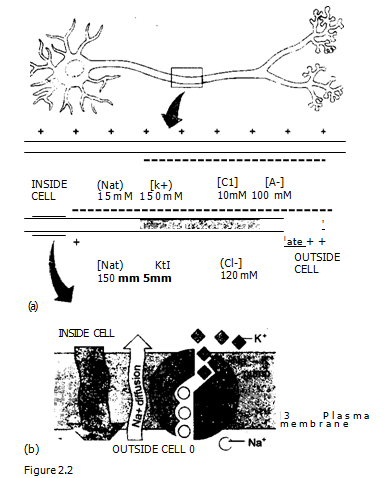
All living cells have an electrical charge difference across their plasma membranes due to ionic imbalances, the inside of the cell being more negative than outside. This difference in charge gives rise to an electrical voltage gradient across the membrane, which can be measured. The voltage measured across the plasma membrane is called the membrane potential. which range from -50 to -100 millivolts (mV) (According to some others it is -60 mV to -80 mV (Campbell). However it is -70 mV in normal resting memory). By convention the voltage outside the cell is called zero, so the minus sign indicates that the inside of the cell is negative with respect to outside. The membrane potential arises from two
things:
i) Differences in the ionic composition of the intracellular and extracellular fluids.
ii) The selective permeability of the plasma membrane, which is the barrier between the two fluids. Fig 2.2

Figure 2.2 The basis of the membrane potential.
 saadia