
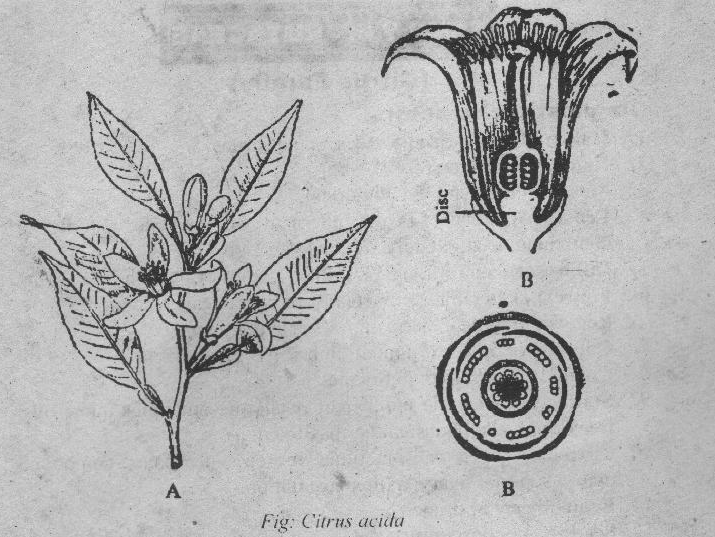
Diagnostic characters
- Habit: Mostly perennial trees, some shrubs.
- Roots: Fibrous tap root
- Stem: Woody; spiny; Cylindrical;
- Leaves: Petiolate; Leave alternate or opposite simple or compound: exstipnlate; reticulate venation.
- Inflorescence: Terminal or axillary cymes or panicle
- Flower: .Pedicifiate; bracteate or ebracteate; actinomorphic; Regular; complete; hermaphrodite; hypogynous:
- Calyx: 4 or 5: free or united; imbricate; green
- Corolla: 4 or 5; free; imbricate:
- Stamens: Twice the number of petals or sometimes numerous:. free or polyadelphous; anther basifixed.
- Carpel: 4 or 5 or sometimes more; syncarpous; compound ovary; superior ovary; axile placentation.
- Fruits: berry or drupe.
- Seed: non-endospermic seed.
Rutaceae Floral formula and floral Diagram


Economic Importance
- Fruits: This family is knportant for citrus fruits like orange.
lemons. sweet lemon and grape fruit. This family is ranked
third in food production. - Medicinal plants: Most of the plants of this family have medicinal importance. Their fruits are rich in vitamins and minerals. Most of vitamin C is extracted from these fruits. Aegle gives tannic acid. Leaves of Alurniya koenigii are used in flavoring. The twigs of Zuntho.xyhtn, akttuni are used as
tooth brushes. Oil of lemon is used in the preparation of mosquito oil. - Ornamental plants: Plants of Afurniva. Ruhr and are cultivated in the garden. firm union is planted as hedge 00 in lawns and parks.
- Uses in perfumes: The large white fragrant flowers and fruits are in perfumes.
Distribution pattern
This family has worldwide distribution. It is large family. It has 120 genera and 900 species. They are mostly distributed in tropical and temperate regions.
Common species
-
Citrus acida (Lime
-
Citrus medial (Lemon ,H)
-
Citrus aurantium (orange)
-
Citrus limetta (sweet lime )
-
Murraya exotica
 abida
abida
Thank you very much.
Its amazing.
Very brief and exact answers.
made for exam
thank you very much
Very very useful,Thank you!